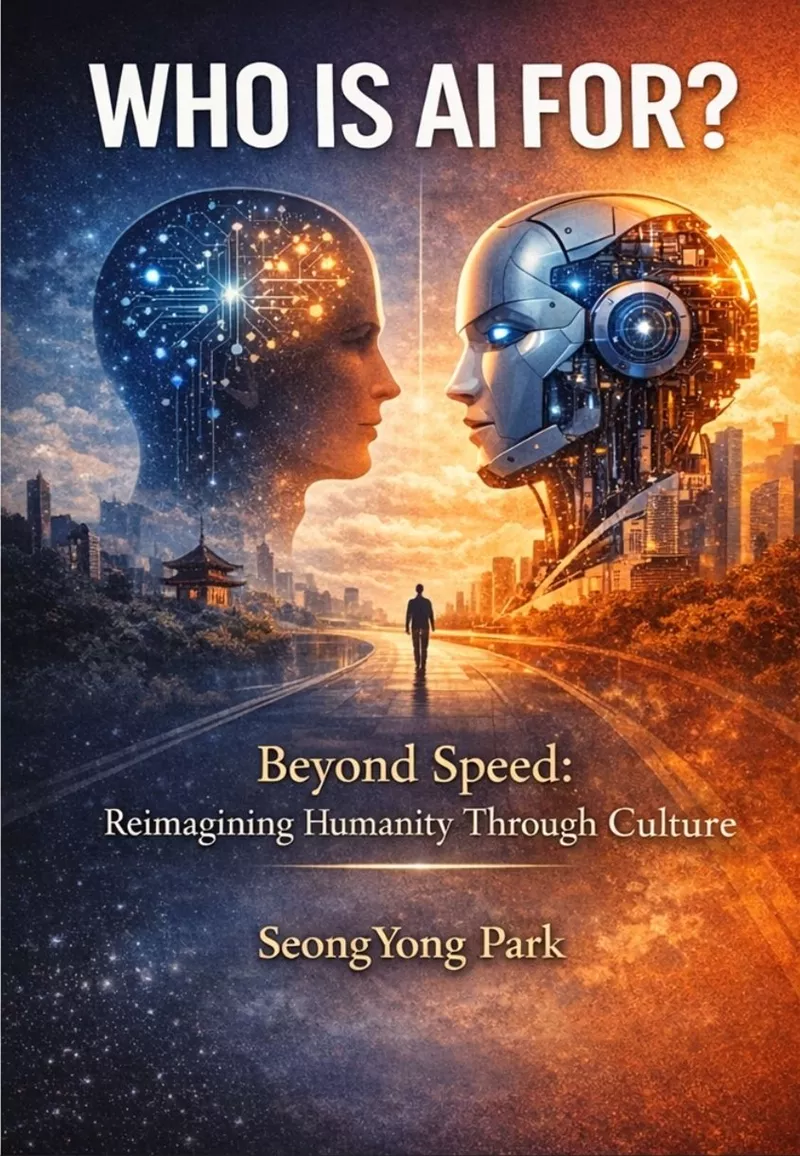
International Cultural Strategist Unveils International Publishing Project on Future of Coexistence with AI
May 18, 2026 Dr. SeongYong Park
“WHO IS AI FOR?” and “Reclaiming the Culture of Peace”: Exploring a Human-Centered Future of AI, Democracy, Culture, and Coexistence in the Era of Technological Acceleration
[Arirang Culture Connect: Seoul] As artificial intelligence (AI) rapidly reshapes education, communication, governance, labor, and everyday social relations, more fundamental questions regarding humanity, coexistence, democracy, and the future of civilization itself are being newly raised in the international community.
Amidst this trend, it has been reported that Dr. SeongYong Park, CEO of Culture Masters and publisher of Arirang Culture Connect, is currently discussing major international publishing projects based on two English manuscripts with overseas academic and international publishers.
Two Manuscripts Currently Under Discussion for International Publication
According to CEO SeongYong Park, this project originated from the awareness that despite the rapid technological advancement of modern civilization, it has failed to sufficiently develop meaningful social systems capable of maintaining human dignity, democratic resilience, cultural continuity, and peaceful coexistence.
First English Manuscript: “WHO IS AI FOR?” This book does not view AI as merely a productivity tool or a system for technological acceleration. Rather, it analyzes AI as a force for civilizational transformation that will fundamentally reshape education, memory, governance, creativity, human relationships, labor, and culture itself in the future. The manuscript is characterized by proposing a human-centered AI framework that transcends efficiency and market logic while encompassing philosophy, cultural studies, pedagogy, intangible heritage, ethics, and international policy discourse.
Second English Manuscript: “Reclaiming the Culture of Peace” This book does not approach peace simply as a political condition or educational agenda. Instead, it presents a broader “Formation Systems” perspective that analyzes how societies continuously shape—or undermine—the emotional, democratic, ecological, cultural, and relational capacities necessary for coexistence across generations. In particular, the manuscript explains that culture functions not merely as artistic activity or heritage preservation, but as an “invisible structure of coexistence” that forms memory, participation, belonging, empathy, and shared humanity.
Connecting AI, Culture, Democracy, and Human Civilization
A common feature of the two manuscripts is their effort to connect intangible heritage and cultural engagement with international discourse on:
AI ethics
Democracy
Coexistence
Education
Future civilization
Dr. Park emphasizes that story transmission, community rituals, intergenerational learning, ecological knowledge, and the practice of intangible heritage all play important roles in preserving relational wisdom—something becoming increasingly essential in a technology-mediated society.
Furthermore, this project expands beyond existing discussions focused primarily on AI governance or conflict management. It attempts to integrate multiple dimensions within a single interdisciplinary framework, including:
Human formation
Democracy
Emotional structures
Cultural continuity
Technological acceleration
Ecological responsibility
Shared humanity
Ongoing International Cooperation and Academic Interest
Dr. SeongYong Park has long been active in UNESCO-related international cultural cooperation and intangible heritage initiatives. Through Culture Masters, he is currently promoting global projects related to:
Education in the AI era
Cultural sustainability
International cultural cooperation
Living heritage
According to officials, the two English manuscripts are currently under review and discussion within international academic and publishing sectors. Possibilities for collaboration with overseas publishers and academic networks are also reportedly being explored.
Experts assess that the themes addressed by this project—including AI ethics, human-centered technology, democracy, cultural sustainability, emotional resilience, coexistence, and the future of humanity—are closely connected to rapidly expanding international discussions within universities, cultural institutions, international policy communities, and UNESCO-related networks. The project is also expected to contribute meaningfully to future interdisciplinary international discussions concerning the relationship between technology, culture, democracy, education, and human civilization.
Academic institutions, international publishers, and researchers interested in related discussions and collaboration can find additional information through Culture Masters. For inquiries, please contact culturemasters.1@gmail.com..