Culture Masters Announces New Vision for a Global Cultural Ecosystem
Jun 02, 2026 Dr. SeongYong Park
At the 7th International Advisory & Directors' Board (IAB) meeting held during Arirang Culture Connect in Seoul, Culture Masters announced a major strategic evolution of its flagship Global Heritage 100 Initiative, alongside a broader vision for building a sustainable global cultural ecosystem.
The meeting marked a significant milestone in the organization's journey, moving beyond project reviews to explore a new model of international cultural cooperation that connects communities, education, technology, research, and global partnerships through the shared goal of safeguarding living heritage.
From Family-Centered Heritage to Living Heritage Communities
One of the most important outcomes of the meeting was the official presentation of the renewed direction of the Global Heritage 100 Initiative.
Over the years, Culture Masters has conducted extensive research on traditional families, kinship communities, and cultural genealogies through projects such as Finding Our Roots. However, discussions with international experts during the 7th IAB meeting led to a shared conclusion: the future of heritage protection requires a broader, more inclusive, and community-centered approach.
"As cultural landscapes continue to evolve, heritage must be understood through the living communities that sustain it," said CEO Park Seong-yong. "Traditional families and kinship groups remain important cultural entities, but living heritage extends far beyond lineage. It includes the performers, practitioners, educators, and communities that actively transmit cultural knowledge across generations."
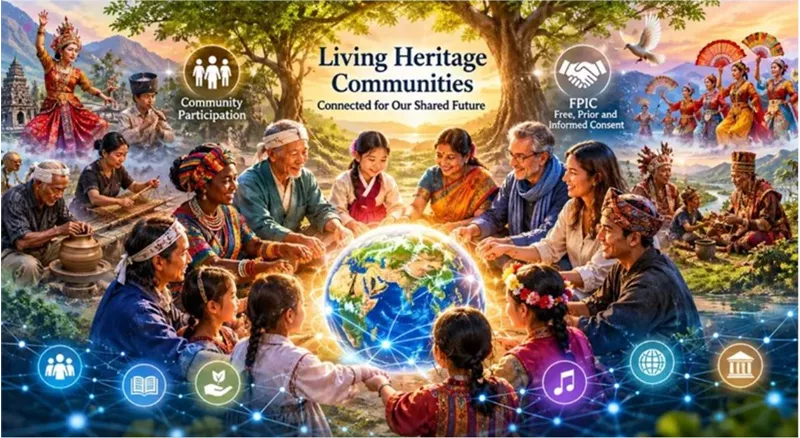
As a result, the Global Heritage 100 Initiative is transitioning from its previous family-centered framework toward a model focused on living heritage communities.
These communities may include practitioners and custodians of:
Traditional performing arts
Craftsmanship and artisan traditions
Indigenous knowledge systems
Rituals and ceremonial practices
Oral traditions and storytelling
Festivals and cultural celebrations
Traditional ecological knowledge
Communities will be evaluated not by lineage, social status, or historical prestige, but through criteria such as:
Strength of cultural transmission systems
Community participation
Intergenerational learning
Cultural resilience
Contributions to cultural diversity
Commitment to safeguarding living heritage
A Historic Commitment to FPIC Principles
A central pillar of the initiative's reform is the formal adoption of FPIC (Free, Prior, and Informed Consent) principles.
Culture Masters emphasized that no community will be documented, featured, or recognized without voluntary participation and informed consent.
IAB members strongly agreed that community participation must be a prerequisite for all heritage-related activities, including collaborations involving UNESCO-listed intangible cultural heritage communities.
Meeting participants shared a common understanding that
"Heritage cannot exist without communities, and recognition without participation is no longer a sustainable form of protection."
By embedding FPIC into the initiative, Culture Masters aims to ensure ethical engagement, respect for cultural rights, and meaningful community ownership in all future programs.
From Recognition to Connection: Building a Living Heritage Community Network
The renewed Global Heritage 100 is not designed simply as a list of distinguished heritage communities.
Instead, it is envisioned as a living heritage community network—a global platform that identifies, connects, and supports exemplary living heritage communities across different regions of the world.
Through international exchanges, educational initiatives, storytelling projects, research collaborations, and digital innovation, Culture Masters seeks to facilitate mutual learning and cooperation among communities.
The initiative aims to strengthen the following:
Cultural diversity
Community-based development
Cultural resilience
Cross-cultural understanding
International solidarity
Ultimately, the goal is to create lasting relationships between communities rather than merely recognizing them.
Introducing the Global Cultural Ecosystem
Among the most forward-looking discussions at the meeting was the presentation of the Global Cultural Ecosystem concept.
The Culture Masters Secretariat provided updates on several interconnected initiatives, including:
iCHMaster's Global Platform & AI Ecosystem
WIN (World Intangible Heritage Network)
CM School
Arirang Master Award
Global Heritage 100
Participants agreed that these initiatives should not operate as separate projects but rather as interconnected components of a single global cultural framework.
The vision is to create an ecosystem that connects:
Living heritage communities
Cultural practitioners and performers
Researchers and scholars
Educational institutions
Cultural organizations
Local governments
Businesses and creative industries
Digital innovators
International organizations
Civil society partners
The discussion also highlighted an important principle for the future:
In the age of artificial intelligence, technology itself is not the priority—people and communities using technology are.
Reimagining WIN as a Global Cooperation Platform
The meeting also explored the future direction of the World Intangible Heritage Network (WIN).
Participants agreed that WIN should evolve beyond a series of cultural events or festivals into a comprehensive global cooperation platform.
Rather than focusing primarily on hosting large-scale events in specific countries, WIN will prioritize:
International network building
Community-to-community exchange
Educational programming
Digital collaboration
Cultural industry partnerships
Youth engagement and leadership
Upcoming initiatives such as the WIN EXPO and the future WIN Grand Festival are expected to function as ongoing platforms for collaboration rather than one-time events.
These platforms will provide practical opportunities for communities and institutions worldwide to connect, learn from one another, and work together on shared cultural goals.
Expanding Global Participation and Partnerships
The IAB meeting also discussed strengthening cooperation between Culture Masters and its sister organizations, including the Association of Traditional Culture and Arts.
To support regional collaboration and expand global participation, proposals included:
Appointing Regional Coordinators in key geographic regions
Expanding public-interest cultural initiatives
Creating more inclusive international participation mechanisms
Establishing a future Global Cultural Forum involving experts, community representatives, partner institutions, and cultural leaders worldwide
These initiatives are designed to create a more open, collaborative, and participatory international cultural network.
Strengthening Cooperation with UNESCO and International Networks
Board members further recommended expanding partnerships with:
UNESCO-related programs
UNESCO Creative Cities Network
International heritage institutions
Universities and research centers
Cultural NGOs
Development and sustainability organizations
Participants agreed that future cultural policy and international cooperation will increasingly depend on interdisciplinary collaboration that connects:
Culture, Education, Technology, Sustainable Development, and Creative Industries.
The meeting also discussed potential future cooperation with cultural events and heritage initiatives across Central Asia, including Uzbekistan.
A Shared Vision for the Future
The 7th International Advisory & Directors' Board Meeting represented more than a strategic review—it became a platform for articulating the future vision of Culture Masters.
Through initiatives such as the Arirang Master Award, ichmasters, WIN, CM School, and Global Heritage 100, the organization aims to build a global cultural ecosystem founded on:
Community participation
Respect for cultural diversity
International cooperation
Digital innovation
Sustainability
Shared responsibility
Reflecting on the discussions, CEO Park Seong-yong concluded:
"The future of heritage lies not merely in preserving traditions. It lies in supporting the communities that keep traditions alive, connecting them with one another, and designing the future together."
Building on the outcomes of the 7th IAB Meeting, Culture Masters is now moving forward with plans to establish a more inclusive, participatory, and sustainable global cultural ecosystem—one where living heritage communities and international partners work together to shape the future of cultural cooperation.
About Global Heritage 100
Global Heritage 100 is an international platform dedicated to identifying, connecting, and supporting exemplary living heritage communities around the world.
Built upon the principles of participation, cultural diversity, shared responsibility, and international cooperation, the initiative seeks to strengthen living heritage safeguarding while contributing to the development of a truly global cultural ecosystem.