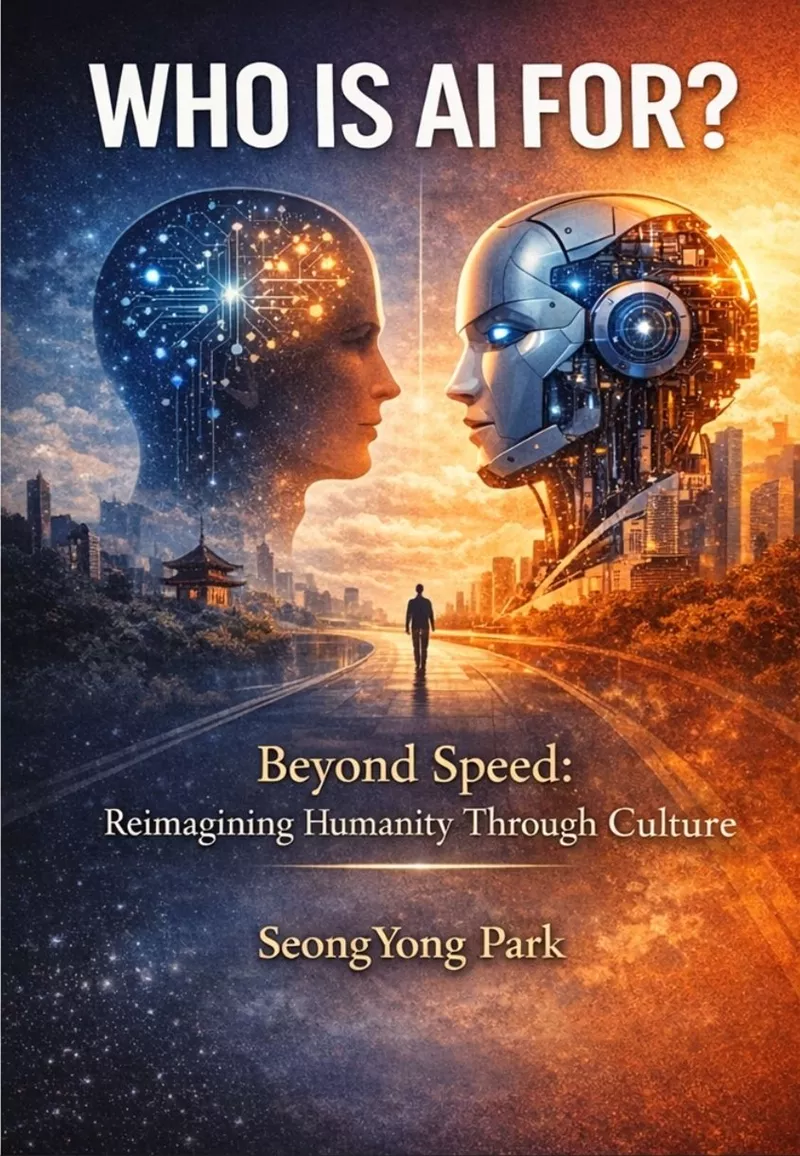
On the New Academic Manuscripts Reclaiming Peace and WHO IS AI FOR?
May 18, 2026 Dr. SeongYong Park
Exploring Human-Centered AI, Culture, Democracy, and the Future of Coexistence
[Arirang Culture Connect: Seoul]
As artificial intelligence (AI) rapidly reshapes education, communication, governance, labor, and everyday social relations, more fundamental questions regarding humanity, coexistence, democracy, and the future of civilization itself are being newly raised in the international community.
Amidst this trend, it has been reported that Dr. SeongYong Park, CEO of Culture Masters and publisher of Arirang Culture Connect, is currently discussing major international publishing projects based on two English manuscripts with overseas academic and international publishers.
Two Manuscripts Currently Under Discussion for International Publication
According to CEO SeongYong Park, this project originated from the awareness that despite the rapid technological advancement of modern civilization, it has failed to sufficiently develop meaningful social systems capable of maintaining human dignity, democratic resilience, cultural continuity, and peaceful coexistence.
First English Manuscript: “WHO IS AI FOR?” This book does not view AI as merely a productivity tool or a system for technological acceleration. Rather, it analyzes AI as a force for civilizational transformation that will fundamentally reshape education, memory, governance, creativity, human relationships, labor, and culture itself in the future. The manuscript is characterized by proposing a human-centered AI framework that transcends efficiency and market logic while encompassing philosophy, cultural studies, pedagogy, intangible heritage, ethics, and international policy discourse.
Second English Manuscript: “Reclaiming the Culture of Peace” This book does not approach peace simply as a political condition or educational agenda. Instead, it presents a broader “Formation Systems” perspective that analyzes how societies continuously shape—or undermine—the emotional, democratic, ecological, cultural, and relational capacities necessary for coexistence across generations. In particular, the manuscript explains that culture functions not merely as artistic activity or heritage preservation, but as an “invisible structure of coexistence” that forms memory, participation, belonging, empathy, and shared humanity.
Connecting AI, Culture, Democracy, and Human Civilization
A common feature of the two manuscripts is their effort to connect intangible heritage and cultural engagement with international discourse on:
AI ethics
Democracy
Coexistence
Education
Future civilization
Dr. Park emphasizes that story transmission, community rituals, intergenerational learning, ecological knowledge, and the practice of intangible heritage all play important roles in preserving relational wisdom—something becoming increasingly essential in a technology-mediated society.
Furthermore, this project expands beyond existing discussions focused primarily on AI governance or conflict management. It attempts to integrate multiple dimensions within a single interdisciplinary framework, including:
Human formation
Democracy
Emotional structures
Cultural continuity
Technological acceleration
Ecological responsibility
Shared humanity
Ongoing International Cooperation and Academic Interest
Dr. SeongYong Park has long been active in UNESCO-related international cultural cooperation and intangible heritage initiatives. Through Culture Masters, he is currently promoting global projects related to:
Education in the AI era
Cultural sustainability
International cultural cooperation
Living heritage
According to officials, the two English manuscripts are currently under review and discussion within international academic and publishing sectors. Possibilities for collaboration with overseas publishers and academic networks are also reportedly being explored.
Experts assess that the themes addressed by this project—including AI ethics, human-centered technology, democracy, cultural sustainability, emotional resilience, coexistence, and the future of humanity—are closely connected to rapidly expanding international discussions within universities, cultural institutions, international policy communities, and UNESCO-related networks. The project is also expected to contribute meaningfully to future interdisciplinary international discussions concerning the relationship between technology, culture, democracy, education, and human civilization.As artificial intelligence (AI) increasingly moves beyond the realm of technical innovation and enters the deeper fabric of human life, more fundamental questions are beginning to emerge across the international community.
Where is humanity heading?
Who should technology ultimately serve?
Can human beings preserve their humanity in the age of AI?
Against this backdrop, two English-language manuscripts authored by Dr. SeongYong Park — CEO of Culture Masters and Publisher of Arirang Culture Connect — are reportedly entering discussions with overseas academic and international publishers.
The manuscripts currently under international consideration are:
WHO IS AI FOR?: Beyond Speed: Reimagining Humanity Through Culture
and
Reclaiming the Culture of Peace: Human Formation, Coexistence, and the Future of Humanity.
Although both works explore the future of humanity in the age of AI, they move in notably different intellectual directions.
The first manuscript, WHO IS AI FOR?, is primarily a philosophical reflection on technological civilization and the meaning of human-centered AI. Rather than viewing AI merely as a tool of automation or efficiency, the manuscript approaches it as a new environment quietly reshaping the ways human beings think, relate, remember, and experience collective life.
At the center of the work lies a growing concern that modern civilization may be gaining speed while gradually losing its sense of direction. Information expands endlessly, yet interpretation weakens. Connectivity deepens, yet trust becomes increasingly fragile. In this atmosphere, the manuscript questions whether technological progress alone can truly sustain human flourishing.
One of the manuscript’s most distinctive ideas is its interpretation of culture. Dr. Park does not describe culture simply as artistic expression or symbolic identity. Instead, culture appears throughout the work as a living civilizational foundation through which people create meaning, sustain relationships, and orient themselves within society.
The manuscript also engages closely with UNESCO’s Recommendation on the Ethics of Artificial Intelligence (2021) and Guidance for Generative AI in Education and Research (2023), arguing that the future of AI cannot be grounded in efficiency alone, but must remain connected to human dignity, cultural diversity, democratic participation, and critical reflection.
Drawing selectively from thinkers such as Hannah Arendt, John Dewey, Martin Heidegger, and Alvin Toffler, the manuscript reflects on how technological systems and platform environments quietly reshape perception, social rhythms, and the texture of everyday life. In this sense, AI appears not merely as a technological innovation, but as part of a deeper civilizational transition.
The author also warns that contemporary societies may gradually be shifting from “technology for humanity” toward “humanity for machines.” In an age increasingly driven by efficiency, speed, market competition, and technological supremacy, human dignity, democratic deliberation, relational sensitivity, and communal responsibility risk being pushed to the margins. The manuscript repeatedly suggests that the most important question is not simply what AI can do, but what kind of human beings societies may ultimately become under technologically accelerated conditions.
In contrast, the second manuscript, Reclaiming the Culture of Peace, turns away from technological philosophy and moves toward questions of human formation, emotional structures, coexistence, and the fragile cultural foundations of peace.
According to those familiar with the project, the work has gained renewed urgency amid the recent resurgence of irrational wars, violence, hatred, polarization, and deepening global instability. While Dr. Park has reportedly spent many years developing the manuscript’s core ideas, recent humanitarian tragedies and expanding social fragmentation appear to have strengthened his determination to bring the work into the international public sphere.
The manuscript asks why societies continue to speak of peace while simultaneously drifting toward emotional fragmentation, democratic fragility, social distrust, ecological anxiety, and increasingly polarized forms of public life.
One of the book’s central ideas is captured in the phrase:
“Peace Is Not Taught. It Is Cultured.”
Rather than understanding human beings as products of formal education alone, the work suggests that people are continuously shaped through culture, media environments, digital platforms, communities, emotional climates, and everyday relational experience.
Within this framework, Dr. Park introduces the concept of “Formation Systems,” suggesting that coexistence is shaped not only through institutions or education, but through the emotional, cultural, and relational environments people inhabit over time.
Drawing selectively from thinkers such as Paulo Freire, Johan Galtung, and John Dewey, the manuscript reflects on how human beings are formed not simply through information, but through participation, memory, relationships, and lived experience.
The work also revisits contemporary discussions on emotion and social fragmentation, suggesting that many modern conflicts emerge not merely from ideological differences, but from wounded emotional climates and increasingly disconnected social realities.
In conversation with UNESCO’s reflections on peace and the future of education, the manuscript ultimately reinterprets the crisis of coexistence not simply as a political problem, but as a deeper crisis of human formation and cultural ecology.
Within this vision, intangible cultural heritage and communal traditions appear not as relics of the past, but as living practices that quietly sustain empathy, reciprocity, shared humanity, and ecological responsibility in an increasingly fragmented world.
The manuscript further argues that many contemporary conflicts are intensified not only by geopolitical tensions, but also by political cultures increasingly driven by emotional mobilization, short-term interests, and fragile leadership. In such conditions, public empathy, democratic trust, and the social capacity for coexistence gradually erode.
Ultimately, Dr. Park suggests that the dangers surrounding AI and the global crisis of peace are not separate problems. When technological competition and emotionally driven politics simultaneously undermine human dignity, happiness, and the foundations of communal life, humanity itself may be pushed toward self-destructive paths shaped by systems of its own making.
A particularly distinctive feature shared by both manuscripts is their effort to connect AI ethics, democracy, culture, peace, education, ecology, platform society, and intangible cultural heritage within a broader civilizational conversation.
Yet the two works ultimately move toward different horizons. WHO IS AI FOR? reflects on the philosophical consequences of technological acceleration and the future of human-centered civilization, while Reclaiming the Culture of Peace seeks to recover the emotional, cultural, and relational foundations necessary for coexistence in an age increasingly marked by conflict and fragmentation.
Observers note that the projects resonate strongly with expanding international discussions surrounding human-centered AI, cultural sustainability, democratic resilience, relational wisdom, and the future of humanity in technologically accelerated societies.
Dr. Park has long been engaged in international cultural cooperation and initiatives related to intangible cultural heritage through UNESCO-connected networks. Through Culture Masters, he is currently developing projects centered on living heritage, AI-era education, cultural sustainability, and international cultural collaboration.
According to sources familiar with the discussions, the manuscripts are currently being reviewed within several international publishing and academic circles, where possibilities for future collaboration are also reportedly under consideration.
Academic institutions, international publishers, and researchers interested in related discussions and collaboration can find additional information through Culture Masters. For inquiries, please contact culturemasters.1@gmail.com.